Materials scientist developing high-performance metallic and rare-earth materials.

I develop advanced materials through alloy design, thermomechanical processing, and materials characterization, connecting processing, microstructure, and mechanical performance.

Professional portrait of Humphrey Wara Odhiambo, Ph.D.
HUMPHREY WARA ODHIAMBO

MY STORY

From mechanical engineering to advanced metallic materials.

My research path spans mechanical engineering, computational fluid–structure interaction, and materials science. I completed my Ph.D. in Materials Science and Engineering at Iowa State University, where I focused on rare-earth-containing aluminum alloys and their performance in demanding thermal environments.

Today, my work centers on designing processing routes that control microstructure and unlock useful combinations of strength, ductility, toughness, and thermal stability.

B.Sc.Mechanical EngineeringKenyatta University · Nairobi, Kenya
M.Sc.Fluid–Structure InteractionsPolytechnique Montréal · Montréal, Quebec, Canada
Ph.D.Materials Science & EngineeringIowa State University of Science and Technology · Ames, Iowa, USA
NowAdvanced Materials R&D

EDUCATION CREDENTIAL

Ph.D. in Materials Science & Engineering

Iowa State University of Science and Technology · 2025

View Credential ↗
RESEARCH DIRECTION

Research Interests

My research focuses on the development, processing, and characterization of advanced metallic and functional materials for demanding engineering applications. I am particularly interested in understanding and controlling process–structure–property relationships to improve mechanical performance, thermal stability, reliability, and manufacturability.

My research spans physical metallurgy, alloy design, thermomechanical processing, high-temperature materials, rare-earth materials, permanent magnets, advanced manufacturing, and materials characterization. My work has included thermally stable Al–Ce-based alloys processed through casting, extrusion, rolling, heat treatment, and rapid solidification, as well as nanograin NdFeB permanent magnets involving powder processing, hot rolling, grain-boundary modification, and magnetic characterization.

Looking forward, I am interested in combining experimental materials development, advanced characterization, computational and data-driven analysis, and process optimization to develop scalable materials and manufacturing technologies for high-temperature, energy, transportation, magnetic, and other advanced engineering applications.

Read Full Research Interests

My research interests center on the development, processing, and characterization of advanced metallic and functional materials for demanding engineering applications. I am particularly interested in understanding and controlling process-structure-property relationships to design materials with improved mechanical performance, thermal stability, reliability, and manufacturability. My broader research interests encompass physical metallurgy, alloy design, thermomechanical processing, high-temperature materials, rare-earth materials, permanent magnets, advanced manufacturing, and materials characterization.

A major focus of my research has been the development of aluminum-cerium (Al-Ce) alloys as thermally stable lightweight materials. My doctoral research investigated how alloy chemistry and thermomechanical processing – including casting, extrusion, rolling, heat treatment, and rapid solidification – can be designed to control microstructure and mechanical properties. Through this work, I developed a strong interest in the fundamental mechanisms governing microstructural evolution, phase stability, deformation, strengthening, and elevated-temperature performance. I am particularly interested in combining advanced characterization and mechanical testing to understand these mechanisms and using that knowledge to guide the development of new alloys and scalable processing routes.

My research interests also extend to rare-earth permanent magnetic materials and their manufacturing. My work on nanograin NdFeB permanent magnets involved powder processing, hot-roll processing, grain-boundary modification, magnetic characterization, and optimization of processing parameters. This experience developed my interest in understanding how grain structure, interfaces, chemistry, and manufacturing conditions influence magnetic performance. I am interested in research that advances high-performance permanent magnets while improving manufacturing efficiency and reducing dependence on constrained critical materials.

Advanced materials characterization is central to my research approach. I am interested in integrating techniques such as SEM, EBSD, EDS, XRD, XRF, optical microscopy, and mechanical testing to quantitatively connect processing conditions with microstructure and material performance. I am also interested in incorporating computational and data-driven approaches into experimental materials research to accelerate the identification of processing–structure–property relationships and guide experimental design.

Looking forward, my goal is to contribute to interdisciplinary research that bridges fundamental materials science with scalable manufacturing. I am particularly interested in developing metallic and functional materials for high-temperature, energy, transportation, magnetic, and other advanced engineering applications. Ultimately, I seek to combine experimental materials development, advanced characterization, computational analysis, and process optimization to develop materials and manufacturing technologies that address critical challenges in performance, sustainability, and resource efficiency.

DOCTORAL RESEARCH

Making aluminum work at higher temperatures.

Conventional aluminum alloys lose substantial strength as temperature rises. My doctoral research investigated Al–Ce-based alloys, combining composition design with thermomechanical processing to create refined, thermally stable microstructures.

~390 MPaUTS achieved in extruded Al–10Ce–4Mg
~86%strength retention after 300 °C / 100 h exposure
260 MPaUTS after hot rolling Al–10Ce–4Mg
~244 HVhardness of melt-spun Al–7Ce–14Cu–0.5Zr

Ph.D. DISSERTATION · IOWA STATE UNIVERSITY · 2025

Thermomechanical processing of Al-Ce-based alloys and their mechanical properties for elevated temperature applications

Doctoral dissertation in Materials Science and Engineering.

View Dissertation ↗

SELECTED PROJECTS

Research through processing, characterization, and performance.

Each project below gives a short overview. Select a project to open the full research story—from the materials challenge and processing route to the microstructure and resulting performance.

01

How extrusion transformed a coarse cast alloy into a strong, ductile, thermally stable material.

Grain refinement and fragmentation of Al₁₁Ce₃ were connected to major improvements in strength, ductility, toughness, and high-temperature stability.

EBSD · XRD · SEM · Tensile · Fracture
Read full storyClose story

The challenge

Cast binary Al–Ce contains a coarse aluminum matrix and a continuous or interconnected Al₁₁Ce₃ intermetallic network. The research question was whether thermomechanical processing could refine this structure without sacrificing the intrinsic thermal stability provided by the Ce-rich phase.

Processing & characterization

The alloy was hot extruded at approximately 300 °C with a large area reduction. SEM and EBSD were used to track fragmentation of the intermetallic phase, grain refinement, and crystallographic texture, while XRD confirmed the principal phases. Tensile and fracture testing connected the evolving microstructure to mechanical behavior.

What the material did

Extrusion refined the aluminum grains from the coarse as-cast scale to roughly the micrometer scale and broke up the Al₁₁Ce₃ network. Room-temperature tensile strength rose to about 250 MPa while ductility increased to roughly 25%. The processed alloy also retained strong mechanical performance after prolonged exposure at 300 °C.

Why it matters

The work showed that Al–Ce alloys can be strengthened through conventional thermomechanical processing while preserving the phase stability needed for elevated-temperature applications. It established the processing–microstructure–property framework that guided the later ternary and multicomponent alloy studies.

02

Adding Mg to raise strength while preserving the thermal stability of the Al–Ce system.

Mg solid-solution strengthening was combined with stable Ce-rich intermetallics to create a substantially stronger alloy after extrusion.

Extrusion · Heat treatment · SEM · EBSD · Mechanical testing
Read full storyClose story

The design idea

The binary Al–Ce system offered excellent thermal stability but limited room-temperature strength. Mg was introduced to add solid-solution strengthening while retaining the thermally stable Al₁₁Ce₃ phase that distinguishes the Al–Ce system.

Processing & characterization

Cast Al–10Ce–4Mg was thermomechanically processed by extrusion and evaluated using SEM, EBSD, XRD, hardness, tensile testing, and fracture measurements. Thermal exposures at 300 °C were used to determine how much of the processed strength survived prolonged heating.

Performance

The extruded ternary alloy reached approximately 390 MPa ultimate tensile strength with about 15% ductility and fracture toughness near 23 kJ/m². After 100 hours at 300 °C, it retained most of its room-temperature strength, demonstrating a useful balance between strengthening and thermal stability.

Why it matters

This study demonstrated a practical alloy-design strategy: use Mg to increase matrix strength and Ce-rich intermetallics to resist microstructural degradation at temperature. The result is an aluminum alloy concept aimed at applications where both low density and sustained elevated-temperature performance are important.

RESEARCH STORY

Processing → microstructure → mechanical response

Microstructural evolution
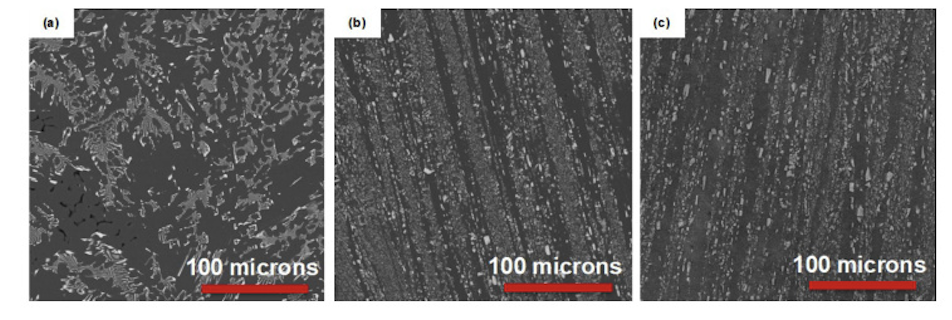
SEM microstructures of Al-10Ce-4Mg in as-cast, extruded, and extruded plus 300 degrees Celsius for 100 hours conditions
(a) As-cast (AC) · (b) Extruded (CE) · (c) Extruded + 300 °C / 100 h (CE-100)

The as-cast alloy contains a relatively coarse α-Al matrix with a Ce-rich intermetallic constituent distributed through the microstructure. Extrusion substantially reorganizes this structure, producing a more refined and directionally aligned morphology along the extrusion direction. After prolonged exposure at 300 °C, the processed structure remains recognizable, indicating resistance to severe microstructural degradation.

Mechanical response
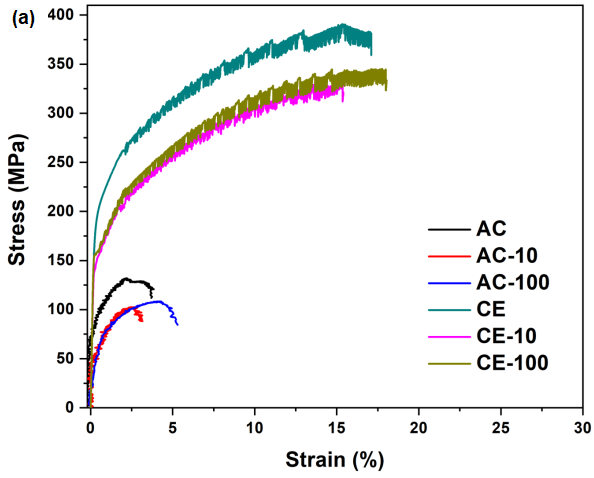
Engineering stress-strain curves for as-cast, extruded, and thermally exposed Al-10Ce-4Mg
Room-temperature engineering stress–strain response of the as-cast, extruded, and thermally exposed conditions.

The stress–strain curves show a pronounced change in mechanical behavior after extrusion. The processed conditions sustain substantially higher stresses while retaining meaningful plastic deformation compared with the as-cast material. The thermally exposed extruded conditions continue to show a strong mechanical response, consistent with the stability observed in the microstructure.

WHY IT MATTERS

Together, the microscopy and tensile response demonstrate the central processing–structure–property relationship of this work. Thermomechanical processing refines and redistributes the strengthening microstructural constituents, while the stable Al–Ce-based intermetallic structure helps preserve the benefits of processing during elevated-temperature exposure. This combination is important for lightweight structural alloys expected to retain useful mechanical performance in demanding thermal environments.

03

Translating the Al–Ce–Mg concept into a hot-rolling route relevant to sheet processing.

A controlled rolling schedule refined the microstructure and substantially increased strength relative to the as-cast alloy.

Rolling · SEM · XRD · EBSD · Hardness · Tensile
Read full storyClose story

The objective

Extrusion demonstrated the strengthening potential of the ternary alloy, but rolling is particularly relevant to scalable sheet and plate manufacturing. The goal was to determine whether a repeatable hot-rolling schedule could create comparable microstructural refinement and property improvement.

The route

Al–10Ce–4Mg was rolled through multiple controlled reductions with reheating between passes. Microstructure and phase stability were assessed by SEM, EBSD, and XRD, while hardness and tensile tests quantified the effect of deformation and subsequent thermal exposure.

Results

Approximately 54% total reduction produced a strong improvement over the cast state, with ultimate tensile strength reaching about 269 MPa. After 100 hours at 300 °C, the rolled material retained about 83% of its UTS and approximately 92% of its yield strength.

Why it matters

The work moved the alloy system toward a more industrially scalable processing route and showed that rolling can provide a useful combination of strengthening, microstructural control, and retention of mechanical properties after thermal exposure.

04

Using melt spinning to push refinement and hardness far beyond the conventionally cast condition.

Rapid solidification generated a highly refined multicomponent microstructure and enabled the study of phase evolution during high-temperature aging.

Melt spinning · Annealing · XRD · SEM · Microhardness
Read full storyClose story

The question

Rapid solidification offers cooling rates far above conventional casting, making it possible to refine phases, extend solubility, and create microstructures that cannot easily be produced by equilibrium processing. The study explored that opportunity in an Al–Ce–Cu–Zr composition.

Processing & characterization

The alloy was produced as thin melt-spun ribbon and then annealed at elevated temperature. XRD and microscopy were used to identify phase evolution, while microhardness tracked the mechanical response of the rapidly solidified and annealed states.

Results

Melt spinning increased hardness to roughly 244 HV compared with about 113 HV in the as-cast condition. The refined microstructure contained α-Al and Ce-rich intermetallic phases, with nanoscale Al₈CeCu₄ and sporadic Al₂CuZr features contributing to the multiscale strengthening response.

Why it matters

The project demonstrated how composition and solidification rate can be used together to engineer high hardness and thermal response. It also broadened the research from conventional bulk thermomechanical processing to nonequilibrium microstructure design.

05

Supporting continuous hot-roll processing of nanograin rare-earth permanent magnets.

Hands-on work connected powder preparation, canning, hot rolling, grain-boundary treatment, and magnetic characterization.

Powder processing · Can welding · Hot rolling · Grain-boundary diffusion · Magnetics
Read full storyClose story

The manufacturing challenge

High-performance NdFeB magnets depend strongly on grain size, texture, interfaces, and processing history. The project focused on continuous hot-roll processing as a route toward dense nanograin magnets with controlled magnetic properties.

My contribution

I supported powder handling and milling, packing, can welding, hot rolling, sample preparation, and magnetic testing. I also participated in grain-boundary diffusion work involving Cu-coated feedstock and process optimization trials.

Outcome

Process optimization produced measurable improvements in coercivity and magnetization, including approximately 3% improvement in key magnetic response during the development work.

Why it matters

This work extended my process-development experience beyond aluminum alloys into rare-earth permanent magnets and reinforced the same core engineering principle: processing controls microstructure, and microstructure controls functional performance.

06

Building hands-on familiarity with thin-film processing, lithography, and semiconductor devices.

Cleanroom fabrication experience covered the process sequence from wafer preparation and patterning to deposition, etching, metallization, and device testing.

Cleanroom · Photolithography · Thin films · CVD/MOCVD · Ga₂O₃ devices
Read full storyClose story

The experience

My semiconductor training introduced the full logic of wafer-scale process integration: how individual deposition, patterning, etching, oxidation, diffusion, and metallization steps must work together to create a functional device.

Hands-on work

I gained laboratory experience with silicon wafer fabrication, thin films, CVD-based processing, photolithography and custom masks, PDMS replication for electrochemical sensors, and fabrication of Ga₂O₃ photodetectors.

What transferred to materials R&D

The work strengthened my understanding of surface preparation, process sequencing, thin-film–substrate interactions, defect control, and characterization at small length scales.

Why it matters

Although my primary research focus is physical metallurgy, this experience gives me a broader process-development perspective and makes it easier to work across metallic materials, coatings, thin films, and device-oriented manufacturing environments.

PUBLICATIONS

Peer-reviewed research on Al–Ce alloy processing and performance.

Selected publications from my doctoral research, spanning extrusion, rolling, alloy development, microstructure, and elevated-temperature stability.

View Google Scholar ↗

2026
JOURNAL ARTICLE

Effect of thermomechanical processing on mechanical properties and the microstructure of ternary Al-Ce-Mg alloy

Gaurav Singh, Humphrey Wara Odhiambo, Mohamad Hasan Bin Tasneem, Gaoyuan Ouyang, Monica A. Soare, Min-chul Kang, Lin Zhou, Jun Cui, Ralph E. Napolitano, Catalin R. Picu.

Journal of Materials Science: Metallurgy · DOI 10.1007/s44492-026-00011-3

View Paper ↗
2026
JOURNAL ARTICLE · EQUAL CONTRIBUTION

Effect of Rolling on the Microstructure and Properties of Cast Al-10Ce-4Mg Alloy

Gaurav Singh, Humphrey Wara Odhiambo, Mohamad Hasan Bin Tasneem, Monica A. Soare, Jun Cui, Ralph E. Napolitano, Catalin R. Picu, Gaoyuan Ouyang.

Materials 19 (2026), 2993

View Paper ↗
2025
CONFERENCE PROCEEDINGS

Al–Ce-Based Alloys: Processing, Mechanical Properties, and High-Temperature Stability

Humphrey Wara Odhiambo, Gaurav Singh, Mohamad Tasneem, Monica A. Soare, Jason Leszczewicz, Jun Cui, Ralph E. Napolitano, Gaoyuan Ouyang, Catalin R. Picu.

Light Metals 2025 · The Minerals, Metals & Materials Society · DOI 10.1007/978-3-031-80676-6_10

View Paper ↗
2024
JOURNAL ARTICLE

Effect of thermomechanical processing on mechanical properties and the microstructure of binary Al-Ce alloy

Gaurav Singh, Humphrey Wara Odhiambo, Mohamad Hasan Bin Tasneem, Gaoyuan Ouyang, Monica A. Soare, Jun Cui, Ralph E. Napolitano, Catalin R. Picu.

Materials Science & Engineering A 916 (2024), 147395 · DOI 10.1016/j.msea.2024.147395

View Paper ↗

CAPABILITIES

Experimental materials science from melt to microstructure.

Processing

Casting, extrusion, rolling, heat treatment, rapid solidification, sintering, powder processing

Characterization

SEM, EDS, EBSD, XRD, XRF, DSC, optical microscopy, fractography

Mechanical testing

Tensile testing, Vickers microhardness, fracture evaluation, elevated-temperature testing

Engineering

MATLAB, Origin, SolidWorks, Inventor, process development, technical documentation

RECOGNITION

Research with measurable impact.

2025 TMS Light Metals Award

Recognition for contributions to Al–Ce alloy research and processing.

DOE / Ames National Laboratory

International Student Scholarship, 2022–2025.

Research mentorship

Mentored four undergraduate researchers in alloy processing and thermomechanical heat treatment.

Contact

Let’s connect

For materials R&D, metallurgy, process development, postdoctoral research, or collaboration opportunities, feel free to reach out.

Send a message

Complete the form below and your message will be sent directly to me.